Signed in as:
filler@godaddy.com

The stained glass windows at St. John’s Anglican Church in Arichat, Cape Breton, hold more than beauty; they hold stories. For me, the “Dore” or “Dorey” window is especially compelling as it tells a tale that’s deeply personal yet profoundly universal.
My family has long been Catholic. My father, his parents, and generations before them were all raised in the Catholic faith. My paternal grandmother came from a proud lineage of French Acadians, steadfast in their faith and traditions. So you can imagine my surprise when I discovered a window in an Anglican church bearing my family’s name.
Tracing my roots, I’ve always known my father’s family came from the Channel Islands, specifically Jersey. Jersey itself is fascinating, with its history shaped by both French and English rule. It’s no wonder the family narrative becomes more complex the deeper I dig. Somewhere along the way, likely in the 1800s, a French Catholic girl and an English Anglican boy crossed religious and cultural divides to marry. At a time when such unions were neither popular nor widely accepted, this act must have been seen as rebellious—an emblem of love and perseverance.
This window is so much more than stained glass; it’s a lens into the past. It speaks of survival, of my ancestors’ transatlantic journey from Europe to Canada across one of the world’s most largest and perilous oceans. It reflects resilience, determination, and, perhaps most strikingly, religious and cultural tolerance in an era when that was far from the norm.
The story becomes even more intriguing when I consider my great-great-grandfather, who was born in Jersey, UK and is buried in an Anglican cemetery in Cape Breton, Nova Scotia. The window, like his life, represents both told and untold histories. While it answers some questions, it raises others, encouraging me to uncover the details of his journey, his struggles, choices and determination that brought my family to where we are today.
Preserving this history is vital, not just for my family but for all of us. These stories, etched in glass and stone, speak of courage, love, and the capacity to bridge divides particularly at a time where there are great divides politically, culturally and socially. The Dorey window at St. John’s is more than a memorial or art; it’s a testament to the human spirit and a reminder that who we are, our history, is as much about what is remembered as what remains to be discovered.
Jamus Dorey

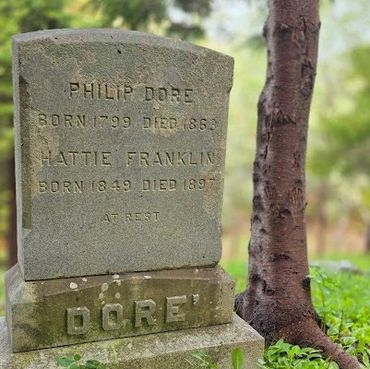
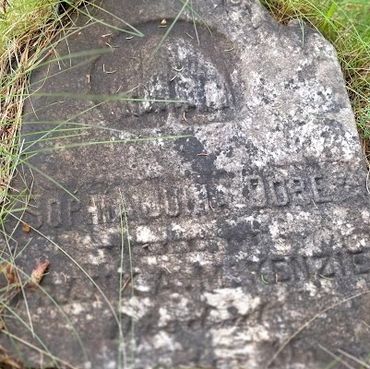
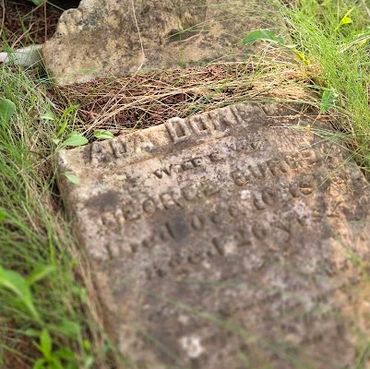
It is likely that the Dorey window was the first stained glass window to have been installed, sometime between 1905 and 1910. This window, in the nave, is the closest to the chancel on the south side of the building. Surrounding the central figure are two intricate crowns: one adorned with delicate wings, while the other features a cross. Reference to the window and its possible origin can be found in Dorey Family of Susan Dorey.

It is believed by Susan Dorey that those memorialized are as follows:


The middle window is a memorial to the Bosdet family. The stained glass window beautifully portrays Jesus as the Good Shepherd, gently cradling a lamb in his arms while surrounded by a flock of sheep. In the vibrant background, a lush tree and field enhance the scene. The flanking panes include the image of a font and chalice.

Reference to the window and its origin can be found in The Bosdet Family History by Paul Bosdet. Accordingly to Paul's work, Thomas, George and Peter Bosdet arrived on Isle Madame in 1842. The 3 brothers, and the descendants of Peter are memorialized in the stained glass window. It is speculated by Paul Bosdet that the window was likely ordered by Mary Ann Bosdet (wife of Peter Bosdet), sometime between the deaths of Cline and Helen in 1905, and her own passing in 1907.
Children of Peter and Mary Ann Bosdet who are named on the window:


Shortly after their arrival, Pierre and George were provided with a mortgage of £385 on 30th January 1849 on land in Arichat, by their brother John Bosdet who remained on his 15-acre farm back in St. Peter, Jersey. Brother Thomas was witness to the document. The mortgage was eventually discharged on the 23 rd January 1856 after John made his brother Thomas Power of Attorney to collect the debt on his behalf.
Pierre is known to have jointly owned a small 16 ton schooner in 1844 called the “Virgin” that was built in Lennox Passage, ship building being a large industry in Nova Scotia at the time. The names of Bosdet and Le Lacheur were connected with the fish trading business in the early days as well as trading as general merchants. He is also recorded as being the owner of the boat “Queen of the Isles” (48 Tons -Reg.34775) in 1867.
Whilst brothers Thomas and George themselves never married, Pierre Bosdet married Mary Ann Fixott on 31 st March 1856 in St John’s Anglican Church, Arichat. Mary Ann was the first of eleven children of Dr. Charles and Tryphosa Elizabeth (nee Hoyt) Fixott, the first physician in Arichat. Pierre and Mary Ann lived in West Arichat, and later Arichat, and had 7 children.
Pierre and Mary Ann were both active in the community, and on November 3 rd , 1860 Pierre was appointed Commissioner of Schools for Richmond County, and again for the District of Richmond on January 3 rd , 1866. Later on July 4 th , 1866 he became Deputy Registrar of births, marriages and deaths for Little Arichat. The first Post Office at West Arichat was opened around 1860 and was managed by Pierre from whose hands it passed to Mr. Emile Mouchet and thence to Capt. A. LeBlanc. West Arichat had two daily mail services and sorted all mail
for Port Royal, a district two miles away, to where it was carried by coach and also for Janvrin's Island, another district in the same parish, where the coach visited twice a week.
Pierre was a great supporter of St John’s Anglican Church where he is recorded as attending a meeting on Easter Monday, 1861, along with David Gruchy; Dr. Henry C. Fixott; John H. Ballam and William R Cutler, Q.C, the latter being the same William Cutler who witnessed the mortgage release document of Pierre and George in 1856. Dr Henry Cline Fixott was his father in law’s brother, Charles Fixott having died nearly seven years earlier in 1854 with Henry taking over the practice. In time, many of these families became related by marriage. After Peter’s own death, they continued to hold services every other Sunday at the home of Peter Cline, his son.

Back row (left to right): Stanley Clement Victor Bosdet and William Albert Bosdet.
Front Row (left to right) Florence Hoyte Bosdet and Mary Ann (Fixott) Bosdet.
Stanley Clement Victor Bosdet
The third son of Pierre Bosdet who in his short life helped his parents run the Sea View Hotel. He ran the stage coach which connected
with the boat service at Grandique Ferry.
William Albert Bosdet.
William Albert Bosdet had many occupations over the years including merchant, farmer, lighthouse keeper and joined the military service during World War I.
Florence Hoyte Bosdet
Florence died of diphtheria shortly before her seventeenth birthday.
Mary Ann Bosdet (Fixott)
Mary Ann was the first of eleven children of Dr. Charles and Tryphosa Elizabeth (nee Hoyt) Fixott, the first physician in Arichat.

Charles Henry Bosdet, was the first born son of Pierre of Arichat and attended McGill University (probably using the inheritance from his uncle Thomas) where he graduated as an electrical engineer when he was aged around 21.
He was hired by the Swedish telephone company Ericson and sent to Mexico to install communications between Mexico City and Puebla. In 1883 he was accompanied by Carlos Downham and the pair contracted with the then Governor of Tiaxcala for the installation of the first telephone lines in the state. Following this initial success they went on to do similar work between Mexico City and Guadalahara and then between Mexico City and Guanajuato (he was working on this latter project when he died). Their work is now celebrated in the Tlaxcala Museum.
In Mexico he met Susana Miller de Pampillon, whose father was said to be from Manchester England and her mother a Mexican. On the 9 th June 1883 they had a joint wedding ceremony with his partner Carlos Downham and Susana’s sister Carolina in Puebla. Whilst living in Guadalajara, Mexico in 1884, Charles appointed his brother Peter Cline, who was still living in Arichat, as attorney to receive on his behalf the monies owed by his father Pierre. For the most part, Charles remained in Mexico though with the birth of his son Ernesto Tomas occurring in Arichat (22nd September, 1885), so it would appear that the couple did undertake some travelling.
In addition to installing telephone links in Mexico, Charles Henry also invented (or imported) a bread slicing machine, invented a tortilla-making machine and imported paraffin to replace tallow then used in Mexican candles. He also invested in the Pachuca Mine in Pachuca Hidalgo, which was later taken over by the Mexico Corp.
Charles Henry’s life ended relatively young when he died after being gored by a bull owned by friends as he pretended to be a bullfighter. In total, Charles Henry Bosdet had four sons: Juan Carlos, Ernesto, Charles, and Enrique. Ernesto and Charles were just 9 and 6 years old when Charles Henry died. Three years later, Ernesto and Charles journeyed on their own from Mexico to Cape Breton to stay with their grandmother (Mary Ann) in Arichat. When their grandmother died in 1907, all the grandchildren were left $5000. Both boys later returned to Mexico.

Titled "Christ Blessing a Child", the Latimer stained glass window beautifully captures Jesus bestowing His blessings upon a child. The scene is enhanced by a vibrant backdrop featuring a lush tree and colorful flowers. The flanking panes feature a dove and a harp.

The Latimer window was erected by Leah B. Latimer - wife of Charles Frederick Latimer and was made in 1955 by Robert McCausland Limited of Toronto. The names on the window are as follows:
Leah B (Smith) Latimer (1870-1958)
Charles F Latimer (1862-1949)
James F Latimer (???? -1904)
Jemima Allen Shaw Latimer (1833-1894)
Rosina J Latimer (1868-1900)


The progenitors of the extended Latimer family of "New Scotland." are CHARLES FREDERICK LATIMER I and JANE DOREY. As far as can be determined from existing records, Charles Latimer was born in Glasgow, Scotland, in the late 1790s. He was an only son but had two sisters, one married and the other engaged at the time he left home. After serving for a short time in his father's bakery, he went to Sweden to work in a textile mill which manufactured broadcloth. During his years in Sweden, the spelling of his name changed to ''Lattemoor''. The business prospered but the young man was not happy in Scandinavia He became part~owner in a trading vessel which made numerous trips across the Atlantic to the New World. On one of these trips , the ship was wrecked off Halifax and Latimer was among the survivors picked up .
The ship that rescued him was bound for Arichat and Latimer landed there. He had no intentions of remaining at first, but he secured temporary employment as a carpenter and cooper, and as the days stretched into weeks and months, began to feel more at home on Ile Madame. He also fell in love with A young immigrant girl from the Channel Islands by the name of Jane Dorey. On July 9, 1823, they were married by a minister of the Church of England, Rev. Charles William Weeks, in Guysborough, N. S. Charles and Jane subsequently had eight children…
Charles F. Latimer was a well-read man. His early education in the Scottish schools had given him a solid foundation on which to build, and he was able to converse in three languages. He had considerable musical ability, was an excellent singer and led the choir in St. John's Anglican Church, Arichat, during the early pastorate of Rev. James Allen Shaw.
He had an outgoing and generous disposition and was a good friend to all who knew him. In fact, he was so generous that he once entered into a very unwise business transaction. In those days, the law did not allow s person to become a Member of Parliament unless he owned property. In order to make it possible for a young lawyer friend named William Young to run for office, Charles Latimer signed his property, including his home, temporarily over to this lawyer.
Shortly after this they moved to Massachusetts, and later to New York City where he was engaged in the business of manufacturing costume jewellery. Old correspondence records that they owned at one time about sixty acres of land around Wall Street. In the economic crash of the 1830s, Charles Latinmer went broke, became ill and subsequently died on August 4, 1838.
The personal journal of Rev. James Allen Shaw records the following fact. At a meeting of the Protestant inhabitants held in the Customs House, Arichat, on February 10, 1828, relative to establishing Ile Madame as a parish, Charles F. Latimer was present among others who subscribed, his contribution of pounds sterling was the third largest. Although it seems a very modest amount to us today, it represented a considerable sacrifice in those days. Charles Latimer also had a share in making a decision on the choice of “St. John’s” as the parish name. It is interesting to note when researching information in the Arichat area (parish records, gravestones, land registry, etc.) that spellings of family names include Latimer, Lattimer, Lattemoor, Lattimoor, Latimore and Lattimore.

James Frederick Latimer was born in Arichat, NS, June 1, 1831, the son of Charles Fredericton Latimer and Jane Dorey...after a brief formal schooling he served an apprenticeship in carpentry. He became a master craftsman at his trade and also developed a skill in masonry. At the age of 29, he was married to Jemima Allen Shaw of Grand River, Richmond County, NS. The wedding was performed in St. John's Church, Arichat on January 3, 1860 by Rev. RF Brine.
James Frederick Latimer purchased property near the Grand Lake, Ile Madame, and cleared enough land for a farm. He built a fine house and large barn on the Grandique Road on a loat measuring 28 by 11 chains.
He was a respected member and regular Church-goer at St. John's, Arichat. He was known as a meticulous craftsman, an honest businessman and tireless worker. His vigor did not wane with age and he was still capable of a days work in the woods or the workshop when he had passed at 70 years. He died May 21, 1904.
The building was constructed in the 1860s. It is pictured circa 1890 and destroyed by fire in 1925.
Jemima Allen Shaw was a person of great beauty and strength of character, and could converse equally well in English, French or Gaelic. She was the daughter of an immigrant schoolmaster, John Shaw Jr of Cumbernaud, Scotland and the niece of Arichat's first Anglican Minister, Rev. James Allen Shaw. Her father gave Lochside, Isle Madame its name, from the Scottish term for lake. Jemima and James had nine children - Charles F, James A, John, Horatio E, Rosina (Roxy), Henry I, George A, Martha A, and Jemima E.
As referenced on the Latimer window itself, Leah B (Smith) Latimer donated the window to St. John's Anglican Church. Leah was the wife of Charles Frederick Latimer (below). The original photo, circa 1880s, includes the contact details for the photographer:
Tracey Artist
913 Washington St and corner of Pleasant St.
Boston
Image source Christiane Carrier Kennedy, 2004
CHARLES FREDERICK LATIMER II was born January 18, 1862, the oldest child of James and Jemima. His early years were spent on his parents' farm on the Grand Digue Road. He went to Massachusetts as a young man and for some years lived on Hanover Street in Boston.
There he went to night school and ultimately learned his trade as a stone and brick mason. He moved into contracting for the Boston Telephone Company and built a system of underground tunnels for phone cables, employing his cousin George F. Latimer and his brothers Jonm, Jim and George A on the project. James Curley, later mayor of Boston, when a young man worked as a timekeeper for Charles, and thereafter they were lifelong friends.
The Latimers named a favorite cocker spaniel pet "Curley" after him. Charles was very active in The Masonic Order, acquiring his 33rd degree. His wife Lead Smith belonged to the Eastern Star and was a Daughter of the Nile. Charles Latimer also belonged to the Imperial Order of Oddfellows. There were no children from their marriage.
Over the years Charles and Leah travelled widely to nearly every state in the U.S.A staying for extended periods of time in the Dakotas. In their later years they purchased and lived in the Marie Gallagher house on the lower street in Arichat. In his eighty-eighth year he underwent major surgery in North Dakota, and passed away in Arichat December I, 1949. The Richmond County Record notes, "His wife who had been his faithful partner in life tenderly cared for him to the last with devotion and loving-kindness". Charles and Leah were the godparents of Florence Dunphy Latimer. He kept the old Latimer Family Bible, inherited from his father James F. Latimer and at Leah's death in 1958, it passed to a grand-nephew, Robert S. Latimer
Circa 1886, US Militia Officer.
This antique 'photograph' is from a collection of Victorian era celluloid-topped tin 'button' portraits made by the Medallion Portrait Co of New York.
Image source: RS Latimer materials, pre-2017.

JANE ROSINA LATIMER or "Roxy" as she was known to community members, was born in Arichat on April 5, 1868, the oldest daughter of James Frederick and Jemima Shaw Latimer. She was baptized in the Church of England by the Rev. R. F. Brine. As a young Woman, she travelled to the United States seeking employment. There she met and eventually married SAMUEL H. BONNER of Greenfield, Ohio. They subsequently moved to Galveston, Texas, where Samuel went into business. Shortly after the birth of their first child - a daughter whose name is not known, and in fact not referred to in some accounts - all three perished tragically in one of the worst natural disasters ever to hit the United States.